
Give us the tree's height on the first call and you'll hear the usual price range for that size. A visit to the tree itself turns that into a firm figure on paper.
How do you know a tree has to come down?
A lean that keeps getting worse is the clearest sign. Cracks where a big limb meets the trunk point the same way.
The ground matters too. Our dominant soil here is Odas loam, and it drains poorly. Roots sitting in saturated ground hold the tree less firmly, so a tree that starts tilting after a wet stretch deserves a closer look. Storm exposure in Redding is low, so wind alone is rarely the reason a tree gives way. More often it's the roots and the soil.
We recommend removal only when the trunk or the root zone is the problem. If it isn't, there are cheaper fixes.
These questions come up on tree pruning jobs. Shopping for tree service in Redding? Our home page has more.
What does removal cost for a small or medium tree?
A tree under 30 feet typically runs $950 to $1,800 to remove. For anything from 30 to 60 feet tall, expect $950 to $1,800.
Access and whatever sits within reach of the fall push the price up or down inside those brackets. An open lawn where the tree can drop whole is the cheapest case. A tree over a fence, a roof or a driveway costs more, because it has to be taken down in sections instead of dropped whole. You see what's covered in writing before we start.
How do you take a tree down without hurting anything?
We mark a drop zone before the first cut. It reaches out to twice the tree's expected height or more, and anyone not on the crew stays outside it while limbs are cut or lowered. On a 40-foot tree that means keeping kids, pets and parked cars 80 feet back, which can include the street.
Getting to the work area safely is the first decision we make. A climber always has a secure tie-in point, including while he moves to a new position. That's slower than free-climbing, and it's how we do it.
Do you need the stump ground too?
Only if you want the space back. A stump left in place won't hurt the yard, but you can't mow over it or plant on it. If you plan to replant or lay sod, we bring in the stump grinder and take it down below ground level.
The written quote shows grinding apart from the removal, so you can decide with both numbers in front of you.
When is removal the wrong answer?
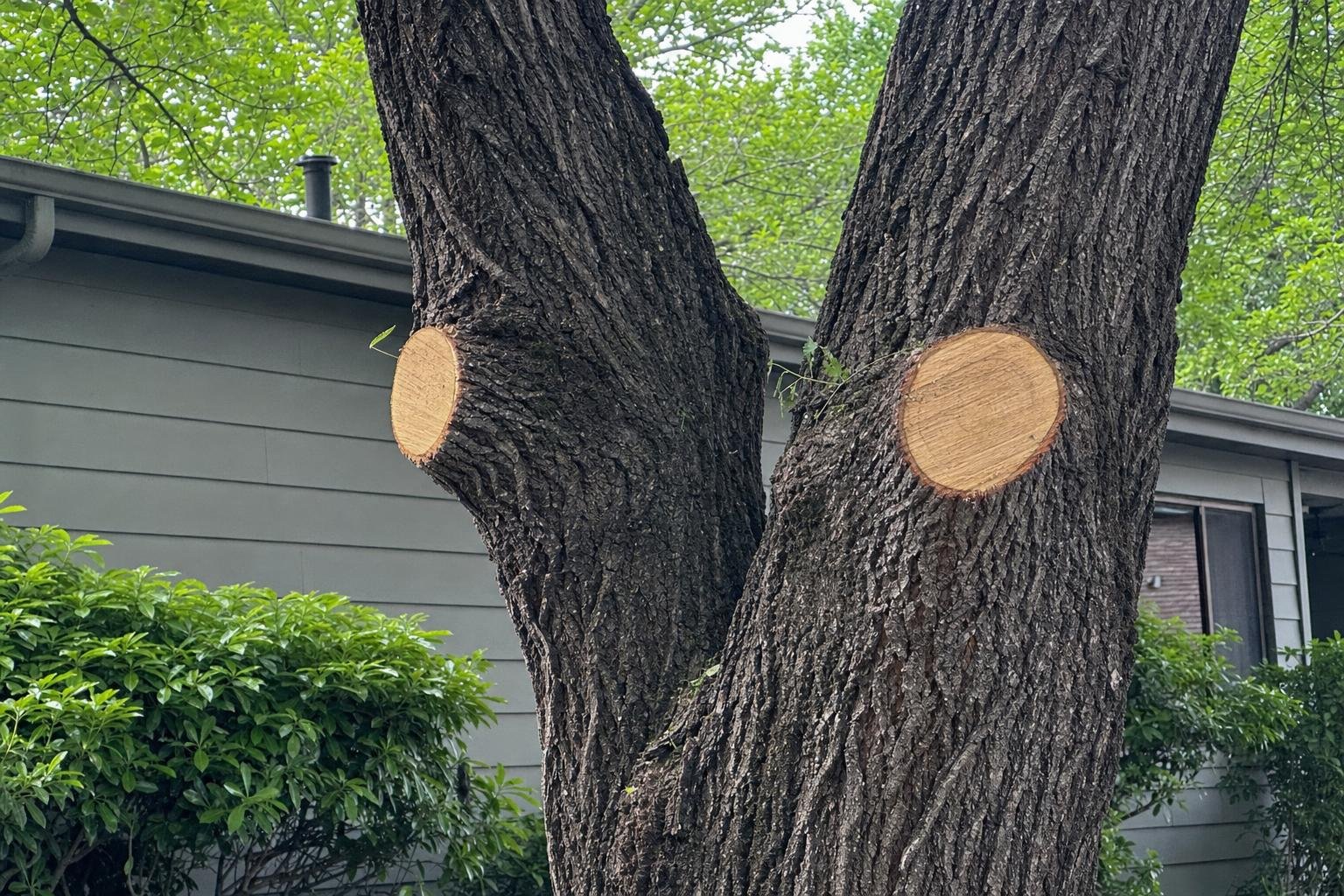
When the trunk is sound and the problem is a few bad limbs, you don't need the whole tree gone. Pruning the limbs fixes it for less money. We cut so the branch collar, the slight swelling where the limb joins the trunk, stays on the tree, not flush to the trunk. The wound seals better that way.
If we look at your tree and think it can stay, we'll tell you so, and we won't write up a removal.
What happens when you call?
On that first call, we ask how tall the tree is, where it stands, and what you've noticed about it. You'll get the typical range for that size right then. You don't have to decide anything on that first contact. If you want to go further, we'll set a time to see the tree and send the written quote.
More Ways We Can Help
Fast Scheduling
Talk it through with us at (530) 319-6300, and it costs nothing to ask.
Estimates · No-pressure scheduling
Updated November 2026