
Or the dead branches you ignored all summer are still hanging there after a wet January. Pruning is cutting back live and dead growth so a tree stays safe over your roof, driveway and yard. North Star Tree Services Co. walks the tree with you first, and the hours and cost are written out before any cutting starts. You'll know whether you need the work at all.
What signs tell you a tree needs pruning?
Dead or broken limbs, branches rubbing each other, or growth pressing against your roof, wires or driveway all mean the tree is due. Any one of those is enough. A limb that looks like a nuisance sometimes needs a single cut and sometimes needs more, which is why North Star Tree Services Co. walks the tree before recommending anything.
Dead wood is the plainest sign: bare twigs in a tree that is otherwise leafed out, or a branch that has snapped and is still hanging. Crossing limbs come next. Two branches that rub in the wind wear through the bark on each other. Weight is the third. A long limb reaching out over a driveway or the roofline carries more load at its tip every year, and it's the one you want shortened before a storm does it for you.
When a winter storm comes through Redding, fallen limbs and downed power lines can turn up together. If a branch is on or touching a line, stay well back and call the utility first. That's not a pruning job. Short of that, we'll go over each limb and separate the urgent cuts from the ones that can sit.
Closely related: tree removal. Want tree service in Redding? Our main page lists everything.
Related reading: What Happens During Tree Service: The Steps Explained · How to Choose a Tree Service Contractor: What a Good Quote Spells Out
What does pruning cost, and what moves the price?
Pruning is billed by the hour, at $60 to $150 an hour. Tree size, how much comes out and how easily the crew can reach it set where your job falls between those two figures. That range is yours for the asking on the first call; the exact figure is firmed up in writing after North Star Tree Services Co. has seen the tree.
Three things push the number up. The first is height, since limbs beyond the reach of a pole pruner take more setup and more time. The second is volume: thinning a whole canopy is more hours than taking out three dead branches. The third is access. A tree behind a fence or leaning over a roof is slower to work than one beside an open driveway.
The price comes down when the job is narrow and clearly defined, like a single limb over the garage or deadwood only. We'll show you how many hours we expect and why.
What actually happens on the day of the work?
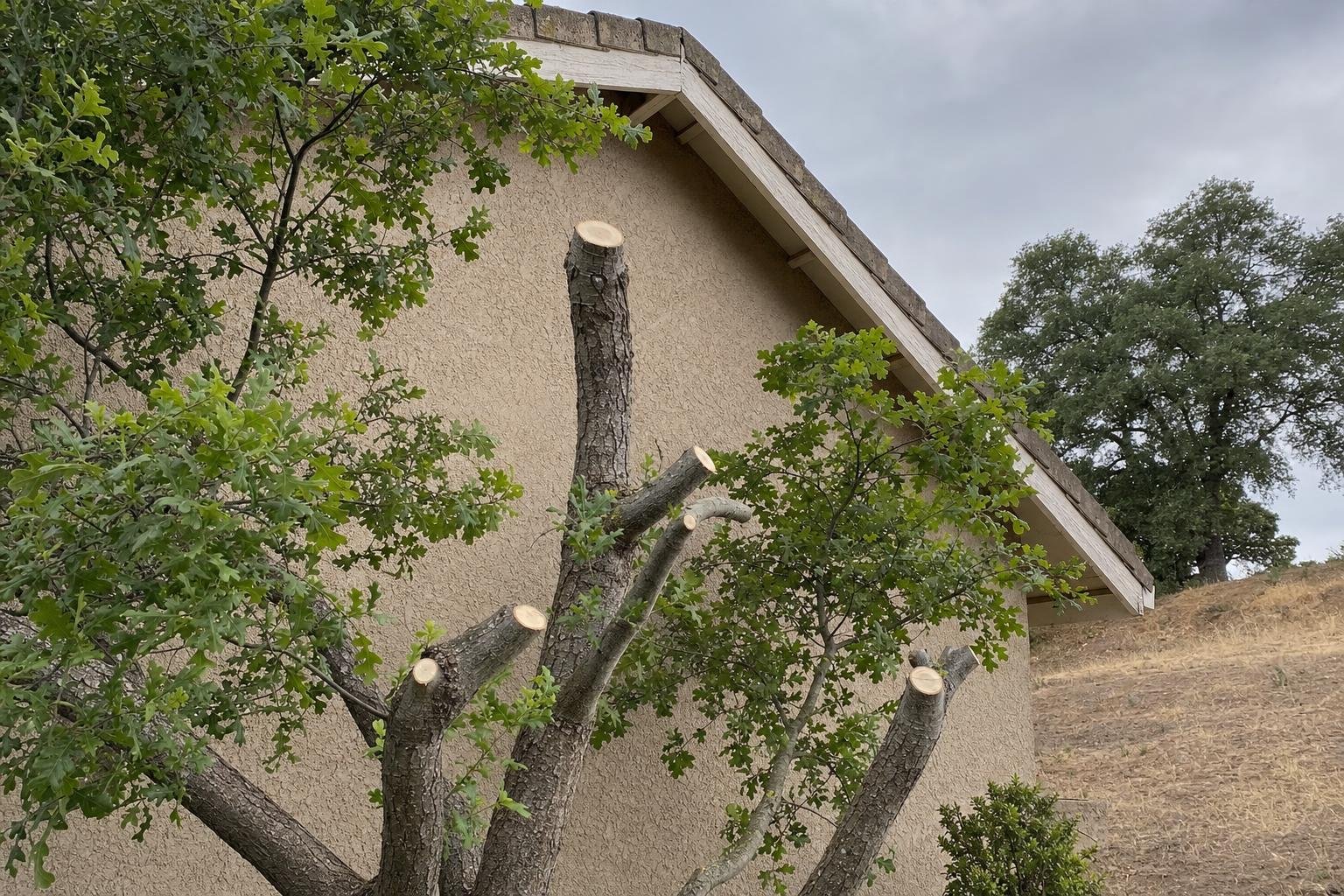
The crew uses a pruning saw and a pole pruner and makes one of two cuts, depending on what the limb is doing. A removal cut takes a branch off at the trunk; a reduction cut shortens it. What comes off is settled at the walk-through, so nothing on the day is a surprise.
The deciding question is whether the limb needs to go or only needs to be shorter. Taking a branch off entirely means cutting outside the collar, the slightly raised ring where the branch meets the trunk, and outside the branch bark ridge. We leave no stub, and we don't cut into the collar. To shorten a limb that has grown too long, we follow it back to a side branch (a lateral) at least one-third the thickness of the piece coming off, so the limb finishes at a branch able to carry the growth instead of a blunt cut.
The pole pruner handles higher growth from the ground. The pruning saw does the heavier cuts on branches within reach.
How long will the pruning take?
There's no fixed length. Time comes down to tree count, height and the amount of wood coming off. A tree with a few dead limbs is a short visit, and one needing weight lifted off a roof edge and a driveway side is a longer one. The expected hours go in your written quote.
What stretches a job most is access. Working around a structure, a fence or a tight yard slows every cut. Because pruning is billed hourly, the time and the price move together.
If we get into the tree and find more deadwood than we could see from the ground, we'll tell you before adding hours, not after.
Does the season change when you should prune?
Mostly it changes how the crew works, not whether the work gets done. Redding has hot, dry summers and cool, wet winters, so summer ground is dry and easy to cross, and winter ground can be soft enough to limit where we set up. A dead or broken limb over your roof shouldn't wait for better weather.
In winter the slow part is dragging limbs across a wet lawn and finding firm footing for the crew, so how the tree sits relative to your lawn and gate shapes the hours. In summer, the dry ground makes access simple.
If you have several trees, we can scope them together and tell you which need work now and which can wait. If trees need to come out and not just back, say so at the start. That's a different scope and gets its own quote.
What happens when you call?
You describe the limb, where it is and roughly how tall the tree stands, and a visit gets booked. Nothing gets committed on that first call.
At the walk-through we'll tell you what needs cutting, what can wait and what it comes to in hours, and you'll have it in writing before any work begins. If the tree doesn't need the work yet, we'll say so. Reach out to North Star Tree Services Co. and we'll start there.
Parts of the Job
Spelled out, parts of it look like this:
- Use a rope or other suitable equipment to lower large branches when needed to avoid damage to the tree, nearby plants, or property.
- Examine the tree and define pruning goals before starting the job.
More Ways We Can Help
Questions Welcome
Phone us and describe the job, no pressure, no obligation.
Estimates · No-pressure scheduling